I’ve been doing a bit of work that’s made me go away and think about OER in more detail than I probably have done in many years.
If you don’t know about OER, they’ve been around nearly as long as I have – and have had their ups and downs. You can find out about OER and how they came to be in this open book – Push Start: OER and IOER for Educators, including the history of OER. UNESCO define OER as:
“Open Educational Resources (OER) are learning, teaching and research materials in any format and medium that reside in the public domain or are under copyright that have been released under an open license, that permit no-cost access, re-use, re-purpose, adaptation and redistribution by others.”
Why OER?
This is a question where the answers may be less obvious since GenAI came onto the scene. The answer used to be about equity of access and reducing costs for students and institutions (SPARC’s page on open education covers this) but now we can all generate our own content using AI’s, these reasons are negated…. right?
Well, no, I don’t believe that is so.
- Equity of access to AI doesn’t exist. Free use is possible but typically more use and better quality models require subscriptions.
- Quality of AI generated content can be questionable. It’s not peer reviewed and can be prone to hallucinations and bias. It’ll confidently tell you something is true when it isn’t.
- Using AI to generate content impacts the environment – if every student on a course asks it to generate effectively the same content, it’ll produce something different every time but also that generation is done each time and the impact on the environment is much bigger. One really good quality resource on a topic, shared with the students, could negate all of that.
Challenges to OER
However, despite the benefits, there are challenges.
I remember when I worked in Biological Sciences at Edinburgh, nearly 23 years ago(!) trying to encourage academic staff to publish course content and materials as OER and getting limited uptake, with the only member of staff who was keen clearly failing to understand other people’s IPR/copyright. I remember Jorum, a UK OER repository which was funded by Jisc and HEFCE, and trying to encouraging staff to use it. Sadly, Jorum was closed in 2016, I think the platform suffered from the same difficulty in getting academic staff to engage with it as I was having. As a School Learning Technologist, I didn’t think too much about this at the time, it didn’t massively impact my job which was very subject/school specific. Stephen Wheeler has a nice blog post to summarise what happened with Jorum and the aftermath. This is just one challenge. Others include the difficulty in finding OER, lack of support from institutions or other staff, training needed before OER development can be started (copyright, licensing, technology, etc).
Developing an OER is no mean feat. Have a look at the ‘Production of OER’ flowchart provided by Billy Meinke from the University of Hawaii (2017).
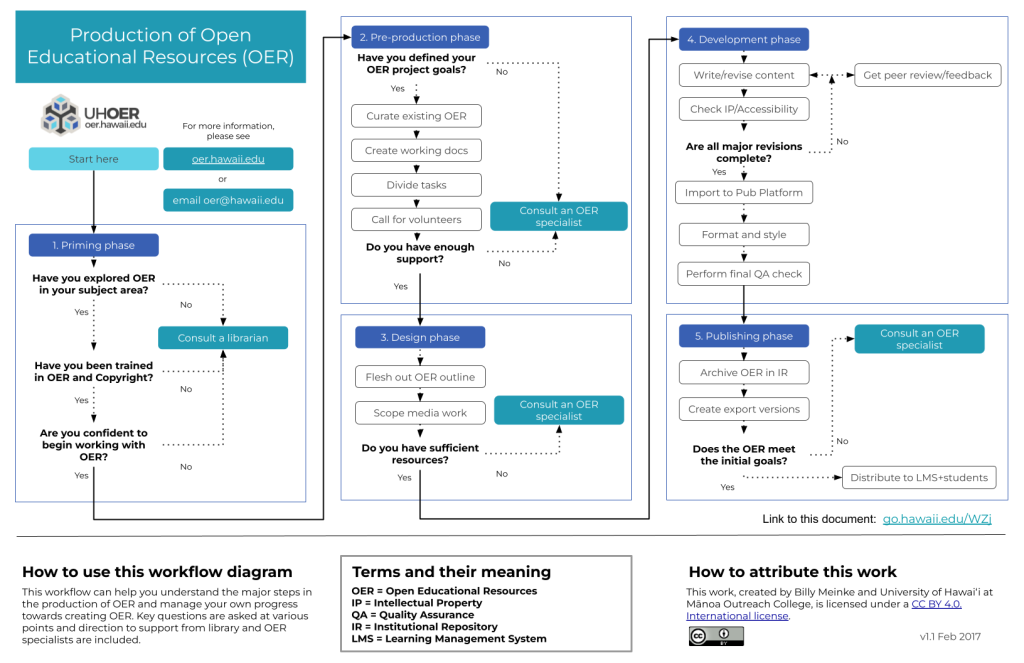
It’s a sensible but complex process – building in various layers of quality control, needed if you genuinely want the OER to be reusable.
Could AI help?
What if we could use AI to help with some of this but still aim to build really good quality OER that other people would want to reuse? Maybe we could help to make OER a bit more mainstream?
- Make it easier to find OER. At the moment, it’s not straightforward to find existing OER to reuse and adapt. There are tools like The Mason OER Metafinder (MOM) which are helpful as a first starting place although when I tested it, I was struggling to get any results from important collections, like OER Commons in the search result even for very general topics like ‘history’. This may be no surprise given the documentation for the OER Commons API site appears to be dead… ** Also, searching for media you can use within your OER is not trivial given the huge number of sites out there offering creative commons licensed media.
- Use AI to help design and implement OER. I genuinely think that AI could help speed up some parts of the process and improve the quality of the OER. You can use AI to help brainstorm, turn your bullet points into something more interesting, create media (where existing open media available doesn’t fit the bill), provide a level of peer review and make your OER more accessible and reusable. At the risk of making things even more complicated,
- Go further with a co-creation/quality assurance/development platform. I think OER Commons and Merlot.org offer collaboration on OER development (OER Commons via their Groups support and Merlot through a more formal peer-review system) but could something be done to provide a mixture of the two – informal feedback when it’s being developed (like the Groups support in OER Commons allowing input and co-creation) and then pre-publication, a more formal peer-review where it is signed off by others.
** Update 03.10.26 – I got a reply from a query from OER Commons to say their APIs were currently not available. I noticed the site was dead back in April so I’m guessing this is a fairly permanent state of affairs 🙁 although I can’t confirm that.
What needs to change?
Policies need to be updated to support the use of AI in the creation of OER, giving updated licensing advice. The University of Edinburgh has recently updated their OER Policy to provide guidance and advice on OER, copyright and AI, which I was really pleased to see. The advice given is really helpful and I look forward to seeing the new guidance they are working on which I think will be helpful for us all.
OER repositories need to be more open themselves – allowing easier searching, live across a number of OER repositories. Clearly there have been attempts made to do this but I’m not sure it is fully working. We want to make sure that OER are as easy to find as possible so new OER are only being created when really necessary.
In this day-and-age of AI, is there a more usable platform to assist people in co-creating OER and working through the process with other like minded people globally?
One of my other thoughts was about whether reuse/remix of existing OER could be done with AI’s help. This is another can of worms entirely – what if the creator of the OER did not consider AI remix of their resource when it was created? How do we know they are happy for it to be used in this way? Of course, Creative Commons are already thinking about this and seem to be doing some interesting work on open licensing and AI through their work on the CC Signals Framework, under development:
“CC Signals will offer a flexible, commons-friendly framework for communicating expectations around AI use of content or data. Just as our licenses offer choices between all and no rights reserved, CC Signals will offer a spectrum of preferences for when and how work is used in AI.”
Phew…
Ok, that’s been a bit of a brain dump. At some point in the future, I’ll try to pick this up again. In the meantime, I’ve reached out to OER Commons to ask about their API. Fingers crossed.