
Ok … so this is not your usual Karen blog post. It’s less about tech and more about my other interest in life – litter and the environment. There’s a lot that frustrates me about how we deal with litter and recycling in the UK… but I do eventually get to the technology bit in this blog post, so please bear with me.
What a load of rubbish!
We have a strange relationship with rubbish in the UK.
We spend enormous amounts of money producing packaging, transporting it around the country, collecting it again, sorting it, recycling some of it, burning or burying some of it – and paying people to clean up the bits that end up scattered across our streets, parks and countryside. (How does it even get there…? Don’t get me started!).
At the same time, we are developing increasingly sophisticated technology capable of recognising objects, sorting materials, driving vehicles autonomously and performing repetitive tasks.
Perhaps it is time to bring those two worlds together. Rather than asking how we can get people to recycle more or drop less litter, we could ask a bigger question:
What could our processes to deal with rubbish look like if we designed them from scratch using the technology available to us today – and the technology likely to become available over the next decade?
Start by making the simple things simple
Before reaching for artificial intelligence or robotics, there are some low-tech improvements we could make.
Improve bins. Public and domestic bins can be overfilled or blow over in the wind, and then can easily be pulled out by wildlife or blown down the street. A simple closing clip or other mechanism that keeps rubbish inside could prevent some litter becoming litter..
Recycling also needs to become much easier. At the moment, what can be recycled – and how it should be recycled – can vary depending on where you live. Packaging labels are not always intuitive either. And don’t get me started on each council area having different coloured bins and using them for different types of rubbish!
We could instead have a standardised national system of recycling bins, colours and symbols. Packaging could be required to display prominently the corresponding symbol showing exactly which bin it belongs in once it’s no longer needed.
You shouldn’t need to understand the properties of different plastics or consult your council website to work out what to do with an empty food container. The system should make the correct choice obvious. This feels like a job for an excellent UI design team!
Better still, what about reuse?
Recycling is better than throwing useful materials away, but it still requires energy and resources. Perhaps we should think much more seriously about reuse.
Instead of every manufacturer designing completely different containers, we could develop sets of standard reusable packaging. Producers could choose from an agreed range of bottles, jars, tubs and containers designed from the outset to survive repeated use.
Once returned, they could be transported to industrial-scale facilities where they were sorted, washed, sterilised and returned to manufacturers and then reused.
Companies would still be able to differentiate their products through labels, sleeves and other design elements, but the container itself could circulate hundreds of times rather than being manufactured, used once, destroyed and replaced.
Give waste a value
One of the most effective ways of changing our relationship with rubbish may simply be to stop treating it as worthless.
Deposit return schemes are an obvious example. If a bottle or can has a financial value when returned, there is an incentive not to throw it away. And when someone does discard it, somebody else has an incentive to pick it up. This was common back in the 80s/early 90s (remember you got 10p back for an empty Barrs bottle?) and is done in a limited way just now but hopefully will get to be more common-place when the Deposit Return Scheme is launched in October 2027. Fingers crossed. Hopefully that won’t be just another confusing set of bins and symbols to get our heads around.
Use technology to do the dirty work
This is where things could become much more interesting. I’ve been thinking about this for a while and when I started to do a bit of research, found there were may ahead of me!
Artificial intelligence is becoming remarkably good at identifying objects in images. Robotics is becoming more capable. Autonomous vehicles already exist. Solar technology continues to improve.
- I developed an app that uses drone footage to track plastic litter on beaches
- Can drones and AI help tackle litter?
Put those technologies together and we can begin to imagine a very different approach to litter.
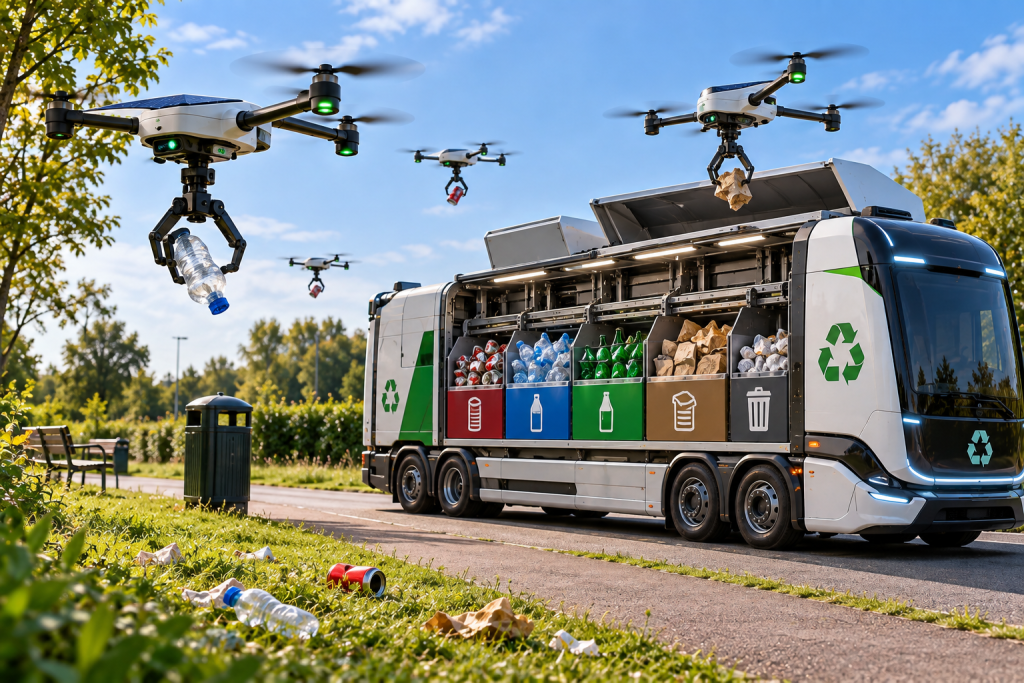
Imagine small, largely solar-powered litter-collecting machines or drones travelling along roadsides, through parks and around public spaces.
AI computer vision could identify objects that don’t belong there and distinguish a drinks can from a crisp packet, bottle, cardboard box or piece of paper.
The machine collects the litter and transports it to a container on a self-driving recycling lorry. It could all be solar powered (or at least solar power topped-up in Scotland…!), but definitely electric.
Rather than simply mixing everything together, the drones would know which container/bin to put the rubbish they’d collected in so the much of the picked litter could be recycled.
It could run for the majority of the day, would just require recharge time.
It wouldn’t remove the responsibility of individuals not to litter, nor would it eliminate the need for human litter pickers. But technology could tackle the enormous volume of repetitive collection work that currently depends on council employees and volunteers walking around with bags and litter pickers.
And unlike a human volunteer, a solar-powered machine doesn’t particularly mind spending six hours looking for Monster drink cans (Speaking from experience…. They are EVERYWHERE!).
I believe this is not all that far away – S, Athul & Baby, Nidhin & M, Nizam & Nipun, Sravan & M, Athira & J, Julia. (2025). Autonomous Litter Detection & Picking Drone. AIJR Proceedings. 7. 124-130. 10.21467/proceedings.7.5.15.
And how about finding the litter culprits using drones/AI for surveillance? This is already happening in Scotland. It is early days but perhaps it will be a deterrent longer term?
Think about the environment more broadly
The same principle can be applied beyond packaging.
We increasingly need large pieces of infrastructure to support our digital lives, including data centres. Those facilities consume substantial amounts of energy and generate heat.
Instead of treating that heat purely as a problem to be managed, we should increasingly regard it as a resource. Where practical, new facilities could be designed alongside heat networks serving nearby homes, hospitals, schools or other public buildings. This is happening already but not enough.
If a community is expected to accommodate major infrastructure, there should be a tangible local benefit from doing so. Supplying recovered heat at a reduced cost could mean that people living beside infrastructure see a direct advantage on their energy bills rather than simply being expected to accept its presence.
When infrastructure creates a useful by-product, we should design systems that find somebody who can use it.
From a waste economy to a circular one
None of these ideas alone will solve Britain’s litter or waste problem. Some are straightforward. Others would require major changes to regulation, infrastructure and manufacturing. Autonomous litter-collecting machines would bring their own technical, environmental, safety and economic questions.
But the important shift is in how we think about the problem.
Our current process is fairly linear but we could instead design a system which loops:
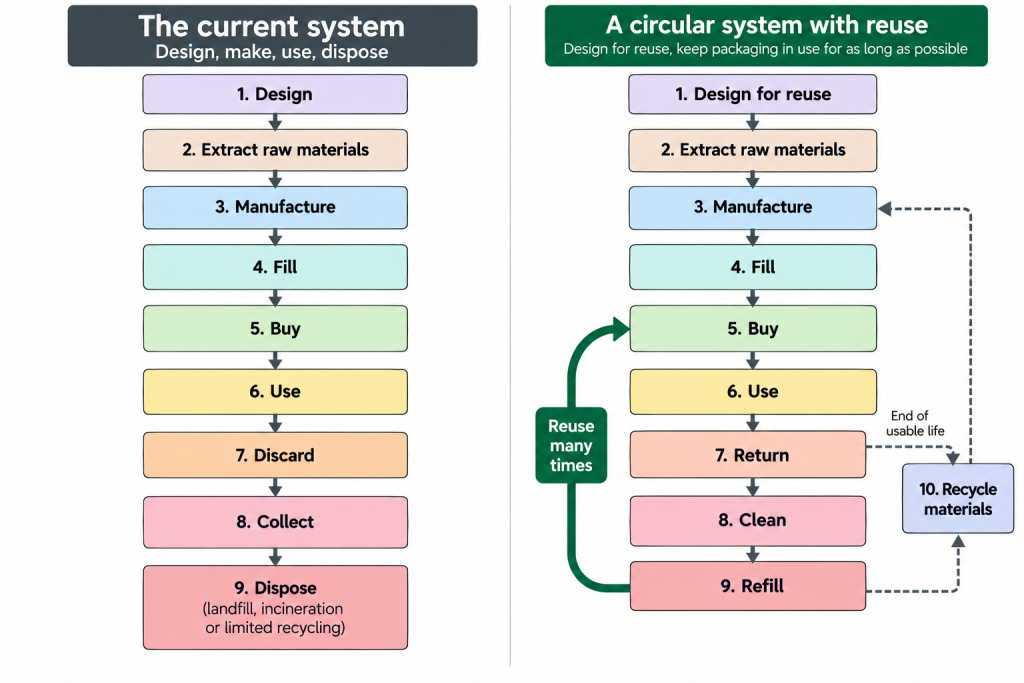
ChatGPT generated image showing current process of use vs my proposed process of reuse. Annoyingly, it’s not rocket science.
Where something cannot be reused, it should be recycled. Where material escapes the system, technology can help recover it. Where infrastructure produces heat or another useful resource, we should try to capture it.
And wherever possible, the easiest and cheapest option for individuals and businesses should also be the environmentally responsible one.
Technology is often discussed as though sustainability requires us to choose between technological progress and protecting the environment.
Perhaps we have that backwards……
The interesting question isn’t whether we should use less technology, in my opinion…… It’s whether we can become much smarter about what we ask technology to do.